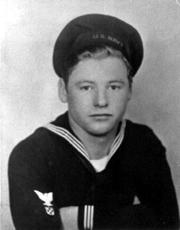
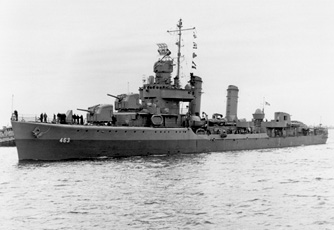
Thomas L. "Red" Groot
Boatswain's Mate, 1st class,
USS Corry (DD-463)
(email: t l g 5 7 1 9 @ s h e n t e l . n e t )
German
Submarine Fires Torpedoes at USS Corry
Sinking of U-801
As
Observed by the NO.3, 5-inch Gun Captain
Thomas “Red” Groot BM1c March 17, 1944
“Submarine Off the Starboard Quarter!”
The
USS Corry was hunting a German sub
southeast of Azores that was first sighted in the area by a plane from the
USS Block Island CVE-21, a baby
carrier, that we were attached to. [Task Force 'TO 21.16'] A
plane from the carrier had spotted a submarine on the surface and strafed it
as it submerged and then dropped a smoke marker to spot the sub's location.
After reporting the sighting to his carrier operation base -- the USS Block
Island -- the destroyer Corry
and a destroyer escort Bronstein,
operating in the area with the task force, were dispatched to the marked
sub's location.
When
we arrived at the scene, the USS Bronstein
was there and had already dropped her smaller charges on her. Then the Corry
took over. She located the sub, dropped charges on her, waited, relocated
her and dropped more charges. After the second run of charges an oil slick
and some trash surfaced. However, Captain Hoffman thought it was a trick by
the sub to make us think we had sunk them, but he wasn't fooled by their
stunt; they were known for tricks of that type.
The
Captain, not convinced she was sunk, kept searching for her. She succeeded
in eluding us for the rest of the day. Using his skill in maneuvering with
an ever-widening search, we picked up a sonar contact on the sub early in
the morning the next day. General
Quarters was sounded and the crew went to battle stations. This time the
Captain tried a different approach of dropping the cans on the sub. Steering
in the direction of the sonar bearings to the sub, taking ranges and
plotting her course and speed, the Captain maneuvered the Corry
directly over her, matching her speed. The
Fathometer, (depth finder), registered its depth and as being over the sub.
The charges for a full pattern were set to that depth. The Captain brought
the ship to a full stop over her, ordered 'fire depth charges' and at the
same time ordered "flank speed ahead" to get away from the
shock-wave and surface eruption of the exploding charges before they went
off. Our ship still took quite a
shock from the explosions, but no damage was reported. From past experience
when the charges are about to go off you raise your heels up off the deck or
you could have some broken heel bones, it's like a sledgehammer hitting your
feet from underneath. The Captain turned back to search the area. The sonar
was a little erratic at the site where the charges exploded but no definite
contact was made for some time after that.
I
imagined that the sub skipper was desperate by now; he fired two torpedoes
at the Corry. The Ocean was dead
calm and with the ship’s engines stopped wasn't making any headway in the
water at that time. With my head
phones on, I had left my gun mount and was standing at the safety rail to
starboard on the after deck house to search the water for anything floating.
It was several minutes since we had dropped the last depth charge pattern on
her. I was looking straight out on the beam to starboard and saw these two
porpoises! At least that is what my first thoughts were when I saw them. It
seems the two of them broached the surface about fifty yards out on the
starboard beam. Seeing wakes following them I instantly knew that they were
torpedoes coming straight at the ship, directly toward where I was standing
on the after deckhouse. As I watched the torpedo wakes on the surface coming
at me, getting closer by the second, I was thinking RUN but knew it wouldn't
do any good so I leaned over the rail to follow them and watch them go off
when they hit the ship's side exactly under me. An instant thought crashed
through my mind that I would always remember what that explosion would look
like. I was expecting a flash and explosion, but nothing! What a rush hit
me, I was still alive. As if from a distance I could hear myself hollering.
They had run directly under the ship where I was standing without exploding.
I then turned to the port side of the ship to see them going away from the
ship on the other side. Unbelievable! Talk about sitting ducks and luck.
If
the torpedoes had hit the ship at that point it would have blown up the
magazines of guns three and four taking the whole after section of the ship
with it and no doubt about it we would have been sunk.
Then
I heard a signalman, Dom Banuelos, standing out on the wing of the bridge
waving his arms and hollering down to me, "Did you see the torpedoes go
under the ship?" I turned
to him and hollered back , “Yeah and there they go” and pointed with my
arm to where the torpedoes were going out to sea. He was probably trying to
warn me before that, but I had frozen watching them coming at me and didn't
hear anything else but the swish of the wakes. I could see the air froth
coming off the torpedo propellers turning into wakes on the surface. Did I
actually see the torpedoes? No, but I saw two dark shadows moving fast, side
by side a six or eight foot spread between them producing twin wakes. I knew
they were torpedoes.
Later,
after the sub was sunk, I talked to several shipmates about why or how the
torpedoes did not find their target. I talked to Matt Jayich of Gun number
Two mount, which is higher up and forward on the ship bow. He told me he saw
the torpedoes pass under the ship at about where the Quarterdeck is located
(Amidships). The number four Gun Captain, BC Mills, saw them go under the
ship at his gun mount. It seems to me that the torpedoes must have gone
under the ship a little forward of his gun mount or he was standing on the
main deck directly below me and we both saw the torpedoes pass under the
ship below us. The Corry's draft
is 15 foot 8 inches, which would mean that the torpedoes likely cleared our
bottom within inches, directly under gun mounts number three and four
magazines. It's a good thing the Corry
was dead in the water at that time, pardon the pun; if she had been under
way she would have been down by the stern. Then there would have been -
"POOF" a lot of smoke and a big glory hole in the Ocean. I guess
it just wasn’t meant to be my fate.
After
the torpedoes went under the ship, the Corry
kicked up speed and went after the sub; establishing a good sonar bearing
and laying a depth charge pattern of several 600 pounders over the suspected
sub's position as the Corry
charged over the contact. Then nothing on sonar, and a long wait. (Sonar
60/65 years ago wasn't what it is today the debris from the depth charge had
to clear off before contact in the area could be made.) The Captain secured
from G. Q. and the condition watch was set. That put me on my watch at the
helm on the bridge. The Captain wasn't through looking for the sub; he was
giving different courses for me to steer. We continued the block search and
back over the location that the last depth charges were laid down. The
Captain sat on the front edge of his chair and took up the course that the
ship was on at the last time the charges were dropped over the sub. After a
few long moments and holding it steady on that course, making about ten
knots, a lookout on the starboard wing of the bridge called out 'there is a
whale off the starboard quarter." I heard another man yell in a more
excited manner, "that's not a whale it's a submarine" and at the
same time I heard sonar getting strong return pings. As I remember, sonar
was hollering, "Contact, bearing 170 degrees at 350 yards."
Things
move into action now. The captain swings out of his chair calling for
"General Quarters" and "Man your battle stations." G.Q
is sounded throughout the ship and at the same time the helm is given
orders, "right full rudder". All this takes place in seconds. The
Captain is making a dash for the starboard wing, I answered back
"Aye, aye sir, right full rudder," turning the wheel at the
same time, hard to starboard. Everett Howard, the quartermaster, takes over
the helm, that's his G Q station. I didn't have to relay my last orders to
him, he was standing right in back of me and said, "I got it". I
made a dash to my G Q station, Gun-mount three, down the ladders from the
bridge, two decks down and aft along the main deck. I could see the sub's
bow cutting through the water a little abaft the starboard beam now cutting
the water as it was surfacing. It's on the same course the Corry was on. As
I hit the main deck running, I’m gonna guess she was making 20 knots, for
a damaged sub that’s pretty darn good. With the Corry’s 10 - knot speed the sub is almost abreast of us, and just
into the turn to starboard I gave it when I left the Helm and gaining speed.
I'm at my Gun Three now on the after deckhouse. My gun crew is already there
and I'm putting on my headset as the word comes over them "Action
starboard" and "Fire when ready" is given. I give the orders
to my gun crew, "Load-match up and shift to automatic". In seconds
I hear my pointer and trainer say, “On automatic” and on top of their
voices I’m calling “Commence firing.” My gun crew managed to get off
three 5 inch rounds at the sub before the gun trained to the stops -- due to
the ship’s swing to starboard, that stopped the gun from firing. All this
happened from the time I left the bridge after giving the wheel that full
right rudder. Before, the ship,
in its swing toward the sub, my gun had trained in a position against the
stops as the sub passed in front of our bow, that stopped my gun from
further firing. Now that's how fast our Corry gun crews act going into
action.
When
our gun was firing I saw a large hole appear in the bow of the sub. You
could see daylight through it. The conning tower was also being hit as the
Germans came spewing up out of her and jumping overboard. That was BC
Mill's, gun Captain of Gun Four that hit the conning tower. They never had a
chance to man their guns. That's something the Corry wasn't going to let
happen. We couldn't have taken the chance for them to get to their deck
guns. Guns One and Two had been firing rapidly but had to check firing when
the Corry came too close for the 5-inch guns to train and fire on the sub.
Still, the small arms fire from our ship’s crew raked her. The Corry,
still swinging around, must have virtually passed over the sub's stern.
The
right turn we were making took us away from the sub. Continuing the turn
opened the distance to the sub to where all our guns could train on it
again. We then commenced firing from starboard, hitting it continually. If
it wasn't damaged enough by our depth charges to sink it, the shellfire did
the job. To make sure it was going down, Captain Hoffman was going to ram it
and announced over the intercom “ Stand by for a ram.” He had a
collision course set for the ram but the sub slipped back under the surface;
her bow rose straight up out of the water and she settled stern-first with
fountains of water and air bellowing up from her bow. She was sinking. The Corry
charged right over the top of her as she went down. I heard sometime later
there were some quiet comments made about the ramming thing by a couple of
the Officers on the Bridge.
There
was a string of men floating in her wake where she was surfacing. So that
sub, the U- 801, was apparently damaged enough by our depth charges to sink
her. Or they had had enough and she was making a run to the surface. Her men
were abandoning the sub as she rose, using escape hatches before she broke
the surface. We picked up 47 men, now German POW's. The sub’s Captain was
killed when he came up on the Bridge and stopped to help his crewmembers out
of the conning tower hatch. Two officers were killed with him.
Several others were killed when the conning tower was hit by
shellfire from the Corry.
By
questioning the POW's it was determined the sub's Captain thought that the Corry
was a US Cruiser and set the depth on the torpedoes accordingly. There were
four DE's with us giving him reason to think that the Corry
was a Light Cruiser. Immediately after missing his target he knew he had
misjudged setting the depth of the torpedoes, realizing too late that it was
a US destroyer; and that by firing the torpedoes he exposed his position.
The
POWs were aboard for several hours before they were turned over to the USS Block
Island, CVE-21. They were treated well while on board the Corry,
given clothing, and they ate in our mess compartment. They were very young
men, most in their teens; blond headed with long hair and they all wanted
combs. Older crewmembers and officers were kept under separate guard away
from the younger group. Captain Hoffman believed they might try to cause
trouble on board our ship if kept together. The young ones thought their sub
was in the Pacific Ocean and were surprised to find out they were in the
Atlantic. Later the Corry pulled
up to the Block Island to take on
fuel and more depth charges. We transferred the prisoners over to the Block Island by makeshift breaches buoys made out of US Mailbags.
We saw several of the younger German prisoners later on, aboard the
Carrier when we were along side of her. They all had their heads cut in a GI
hair cut and dressed in POW uniforms. They seemed happy though the war was
over for them, especially after the horror experienced with two days of
being depth charged by us, thinking their sub would be their tomb.
Before
transferring them to the carrier, Captain Hoffman held a burial service at
sea on board the Corry for their
Captain and the others killed that we had picked up from the sea. Their
bodies, weighted and sewn up in canvas, slid off into the sea with prayer
under the German flag. The prisoners were all present for this service.
USS
Block Island, CVE-21, was an old
transport ship converted to a small aircraft carrier (baby carrier) with a
dozen or more planes assigned to it. The USS Corry joined with her and the four DE's at Casablanca. That
comprised Submarine Hunter Killer task force TO 21.16. We were at sea for
six months without seeing land with this force. This Task Force was credited
with sinking seven submarines in that six-month period.
USS
CORRY DD 463 sank the U-801 German Submarine by shellfire on March 17, 1944.
USS
Block Island (CVE-21) was sunk
after being torpedoed by a German submarine U-549 northwest of the Canary
Islands, 29th of May 1944. Ironically, that is in the same area from where
the USS Corry sank the U-801 while
operating with the carrier just three months and twelve days earlier from
the Corry's sinking of June 6,
1944.
Thomas
'Red' Groot, BM1c
© 2006Thomas L. Groot
~~~~Recently, (2009) looking
through records I found out through the Navy Archives the Torpedoes fired at
the Corry from the U-801 were type T-5 German type Acoustic Torpedoes with
combination inertia and magnetic firing Pistol. The magnetic firing was
always set in the on position and the T- 5 Torpedo never circles; if torpedo
goes beyond acoustic range, torpedo continues on straight course. The
Listening arc of the T-5 Torpedo hears 180 degrees around its nose.
The Corry’s engines were not running when the torpedoes were fired
and then passing underneath us; there was no sound to trigger the Torpedo
combination inertia and magnetic firing pistol. A second reason the U-801
may have been too close to us for the Torpedoes Safety-run Pistol-arming
distance between 260-270 meters (240 yards. -248 yards.) to arm their
warheads. I sited them breaching the surface at 60 yards. If the torpedoes
had hit the ship they still would not have went off with the German inertia
pistol. This is my opinion as to why the Torpedoes never went off while
passing close beneath us. It was
said by one of the crewmembers of the sub that the sub’s Captain thought
the Corry was a US Cruiser and set the Torpedoes running depth for a
Cruiser. Captain Hans Joachim Brans, of the Sub was a very clever man and I
don’t think he would make such a mistake. They were just fired in a
desperate haste maybe by using their Sonar gear for directing the firing
run. It was reported that her periscope had been damaged earlier in the
plane attack on the sub. ~~~~
Red Groot BM1 USS Corry DD 463
© 2009 Thomas L. Groot